
Choosing a Mining Company: Hosting, Maintenance and Machine Supply
Three services decide what a mining company is worth to you: rack space and power, maintenance, and machines. Take one 100 TH/s unit built at 20 J/TH. It draws 48 kWh a day, which costs $3.60 at a hosting rate of $0.075/kWh against $3.88 of income after the listed 4% fee — about $0.28 a day of margin. At $0.06/kWh the same machine keeps $1.00 a day. The power rate is therefore the first number to read, well before the sales page.
Key takeaways
- Power price decides the margin. At 20 J/TH the breakeven tariff is about $0.0841/kWh gross and $0.0808/kWh after the listed 4% block-reward fee.
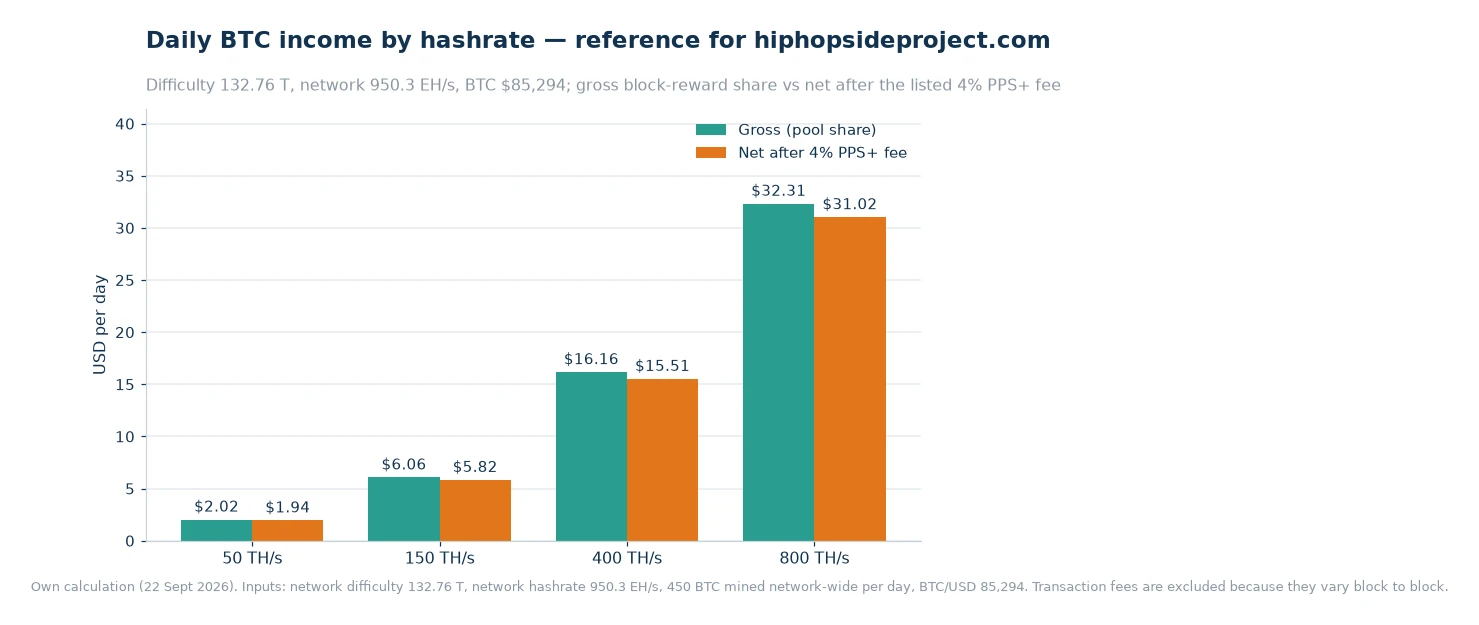
- At 400 TH/s, gross income is about $16.16 a day and $15.51 after that fee, while 192 kWh a day of power costs $11.52 at $0.06/kWh.
- Maintenance is a turnaround promise, not a department. Ask how many days a failed board takes and who pays the courier.
- Machine supply hinges on joules per terahash, because a 15 J/TH unit tolerates a tariff that starves a 25 J/TH unit.
What a host actually sells
Miner Hosting is a contract for electricity, cooling, connectivity and a slot in a building. The machines are yours; the cost of running them is theirs to bill. That makes the tariff the core of the agreement and the uptime the core of the service level, and both belong in writing with a number attached. A host quoting a rate per kWh should also state whether it is metered at the wall, whether the subtotal includes cooling overhead, and what rate applies when the machines are idle.
Uptime deserves the same treatment. A promise of availability means one thing when a board fails and another when the transmission operator asks the site to curtail during a peak. Ask how many hours of interruption the contract permits per month, what credit applies when the site exceeds it, and whether a curtailment event counts as an interruption. At 400 TH/s a halted fleet loses about $0.65 an hour of net income, so 24 hours of unplanned downtime is roughly $15.50 of forgone output — small in a good month, material across a year.
Maintenance, spares and the cost of waiting
Repair logistics decide how much of your hashrate is idle at any moment. A site with spare boards on the shelf can swap a failed unit the same day and repair the original later; a site that ships every fault back to a manufacturer leaves you waiting weeks. Ask what the spare ratio is, who holds the spares, and whether the repair is done on site or by a third party. Ask too about firmware and overclocking rules, because a host that pushes boards past their rated efficiency to win a benchmark will shorten the interval between failures.
Then price the downtime honestly. Every day a 400 TH/s unit sits on a bench costs about $15.51 of net income at current difficulty, which is more than a month of the same machine's power at $0.06/kWh. The repair cost is rarely the expensive part of a fault; the idle hashrate is.
Machine supply and the joules that matter
When a company also sells machines, the specification that matters is efficiency in joules per terahash, because it converts directly into a power bill. A 15 J/TH unit draws 0.36 kWh per TH/s a day and stays viable at tariffs up to $0.1122/kWh gross, or $0.1077/kWh after the listed fee. A 20 J/TH unit needs 0.48 kWh per TH/s and breaks even at $0.0841/kWh gross. The same hashrate can therefore be a sound purchase at one site and a loss leader at another, purely on the power contract.
Ask what the machine actually achieves at the wall rather than at the datasheet, and check the daily output against your own hashrate figure. At difficulty 132.76 T, 50 TH/s produces about $2.02 a day gross and $1.94 after the fee; 400 TH/s produces $16.16 and $15.51. Those are the numbers a supply quote should be compared against, along with the delivery date.
| Service | Question to ask | Number that answers it |
|---|---|---|
| Power and rack space | What is the all-in tariff per kWh, and is it metered at the wall? | Breakeven about $0.0841/kWh at 20 J/TH, or $0.0808/kWh after the listed 4% fee |
| Uptime | How many interruption hours are permitted, and what credit applies? | 400 TH/s earns about $0.65 an hour net, $15.51 a day |
| Maintenance | Spare ratio, turnaround days, who pays shipping? | Each idle day at 400 TH/s costs about $15.51 of net output |
| Machine supply | Efficiency at the wall, delivery date, warranty terms | 15 J/TH survives a tariff that 25 J/TH cannot |
| Payout path | Where does income land and how often? | PPS+ settles hourly; PPLNS pays after 6 confirmations over the last 5 rounds |
Worked example: 400 TH/s against two power rates
A 400 TH/s fleet at 20 J/TH draws 192 kWh a day. Gross income is 400 multiplied by the per-TH/s figure of $0.0404, which is $16.16 a day, and after the listed 4% charge on the block-reward component it is $15.51. Over 30 days that is $465.30 net.
At a hosting rate of $0.06/kWh the power bill is 192 multiplied by 0.06, or $11.52 a day and $345.60 a month, leaving about $119.70 of monthly margin before any management fee. At $0.075/kWh the same fleet pays $14.40 a day and $432 a month, leaving $33.30 — the tariff moved two cents and the margin fell by 72%.
Now hold the tariff at $0.06/kWh and change the hardware to 15 J/TH. Power drops to 144 kWh a day, or $8.64, and the same $15.51 of net income leaves $206.70 a month — nearly double the margin, from the same rent. Efficiency and tariff are one decision, not two.
Where a listing shortens the search
The value of a published directory of Mining Companies is that it puts the operator, the site and the service in one place, so questions about tariffs, spares and contracts can be asked before a machine is shipped anywhere. A listing will not tell you whether a particular contract is fair, but it does let you compare several hosts against the same set of questions, which is how the power-rate arithmetic above gets a real number plugged into it.
Start from the ViaBTC Mining Companies directory for firms that host and supply machines, then check the same operators against the Mining Farms listings if you want a site-level view of capacity. Treat both as a starting point for a call, and bring the four questions from the table above to it.
Frequently asked questions
What is the single most important term in a hosting contract?
The power rate, including how it is metered and whether it can be raised mid-term. At 20 J/TH, anything above roughly $0.0841/kWh gross leaves no margin at today's difficulty.
Should I buy machines from the same company that hosts them?
Not necessarily, but it simplifies repairs and warranty claims. Compare the machine's wall efficiency and delivery date against the same figures from an independent supplier before deciding.
How much downtime is normal?
Ask the host for its permitted interruption hours per month and the credit that applies beyond them. Each day of downtime at 400 TH/s is about $15.51 of net output, so the number should be small and written down.
Does the payout method matter if someone else runs the machines?
Yes, because it sets when the income that pays the invoice actually arrives. PPS+ settles hourly at current difficulty, while PPLNS distributes after the pool's block reaches six confirmations.
Do the arithmetic before the site visit
Write down four numbers: hashrate in TH/s, efficiency in J/TH, the all-in power tariff, and the net daily income figure. Multiply to get the power bill, subtract it from net income, and multiply by 30. If the result is thin at today's difficulty, the contract has to be renegotiated or the hardware changed, because the next adjustment — estimated at about +1.90% — will not improve it. Only after that arithmetic makes sense is it worth discussing spare ratios and delivery dates.
Data and sources: the ViaBTC directory of mining companies[1], mining farms listings[2] and the published fee schedule for the listed 4% PPS+ rate[3]. Data read 22 Sept 2026 with difficulty at 132.76 T, network hashrate at about 950.3 EH/s and BTC at $85,294. Tariffs and hosting costs are illustrative rather than quoted, and nothing on this page is a promise of earnings.